Monday, March 17, 2008

Puzzles

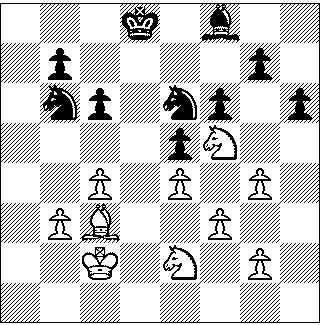
Here is a set of tactical puzzles; do give them a try and I will post the solutions in a week or so.


1) White to play:


2) White to play:


3) Black to play:


4) Black to play:


5) White to play:


6) White to play:


Saturday, February 02, 2008

Update: New Blog Title!

Given my tally of 11 posts in about 2 years, I thought it might be a little too taxing on my readers to contine seeing this blog called 'Your Daily Dose of Chess'. Hence the new and improved title that you see on the top left-hand corner of this page. I also take this opportunity to humbly apologise to all those readers who, misled by the previous title, religiously checked the blog every morning only to return home disappointed.

Moving on, I will be posting a set of puzzles within the next two weeks. They will be of varying difficulty and having varying themes, so they should be interesting. And no, this is not another one of my false promises because this happens to be something about which I have no choice. So stay tuned!

Saturday, May 19, 2007

The art of evaluation 1

What is the quality that for most people defines a good chessplayer? It is the ability to analyse deeply, the ability to transform, without physically moving the pieces, the position on the board into something wildly different, all in the mind’s eye. Yet what is often ignored is the more subtle, yet equally important skill- evaluation. In this and the next few articles, I will discuss some of the issues inolved in evaluation- how to evaluate a position, deciding when to analyse and when to evaluate, and finally what you can do to improve your evaluation skills.

A little thought makes it clear why evaluation is important. However well you can analyse, a point comes when you have to stop, when analysing further is fruitless. Usually this is when a 'quiet' position arises in your analysis, in which the next few moves are not likely to change the complexion of the game. How do you decide, then, whether the original move was good? The only way to do so is to evaluate or judge the resulting position and decide who is better, and this is where your evaluation skills come in. Good evaluation can easily mean the difference between a won and a lost game, which is why the lack of importance often attached to it is all the more baffling.

Just to set things off, here’s a position that might have arisen in a game of mine. It’s black to move.


1. … exd5 looks obvious, when the game is just about even. While White has pressure against the weak c-pawn, this is counterbalanced somewhat by white's k-side light-squared weaknesses as well as the fact that black’s bishop is better than white’s.

However Black also has the interesting choice of 1. … Qxd5!? 2. Qxc7 Bf6 3. e3 (3. Be3 Bxd4; 3. Rd1 Rfc8 4. Qf4 e5!) Rfc8 4. Qf4 Rc2, when black clearly has some compensation for the pawn- his pieces are very active and it isn't easy for white to develop his queenside pieces.

The question is, how does black decide whether to play 1. … exd5 or 1. … Qxd5? Obviously in order to do that black has to evaluate the positions after 1. … exd5 and 4. … Rc2, and decide which one is better. Here we see the importance of evaluation- a player with good calculation and visualization skills can easily find both variations, but without good evaluation skills he might well end up choosing the wrong option. ‘Seeing’ is not everything; you also have to understand what you see!

We will be coming back to the above position from time to time as we further explore the fascinating, if at times frustrating, process of evaluation. Until next time, adieu!

Wednesday, August 16, 2006

Opening views

Openings... this most elusive part of a chess game. For some of us it barely passes in a flash, nothing but a prelude to bigger and better things; for others the opening is chess, to be studied and prepared before games, to be applied purposefully during games, to be analysed after games. Whatever way you look at the opening, it is without doubt one of the most crucial stages of the game; so it is important to have one's own approach towards openings.

The first thing to realize is that if your approach is over-simplistic it's probably not particularly great. Just about every chess coach preaches, "Don't memorize openings, just learn a few opening rules and you'll be fine etc etc" and of course there is no doubt that heavy memorization of openings is unhelpful. But it is also easy to lean to the other extreme and purposely avoid memorizing any lines at all, if only to stick to a principle. The result can be too many games going something like e4 e5 Nf3 Nc6 Nc3 Nf6 Bc4 Bc5 d3 d6 etc, and by the time you reach the middlegame you realize you have reached a stale dull position which you just hate to play. So there has to be a compromise of some sort- you need to know the principles well because you are bound to play games where you or your opponent veer out of the main line, and also because it saves time which you can use to learn other aspects of chess; but some memorization is required if you are going to get good positions out of the opening.

A second point to consider is what opening to play; and this depends very much on your chess style. A fundamental decision to make is whether to play 1. e4 or 1. d4 (or other openings such as 1. c4 or 1. Nf3). The common rule-of-thumb is that if you have a 'positional' style play 1. d4; if instead you have a 'tactical' style play 1. e4. It is a useful guidline but not completely true of course; there is plenty of scope for dynamic play with 1. d4 (many of the lines in the QGD or Slav where white allows black to win the c4 pawn) and many grandmasters with quieter styles have nevertheless played 1. e4 (Karpov is a good example). Another decision to make is what openings to play as Black against the common white openings. But I think more important than what opening you choose is how you play it. A good method I think is to understand the point of the opening, so to speak, and know the plans from typical positions that arise from the opening. Then browse quickly through a few main lines and skim through a few games in the opening, just to get a feel for what kind of moves are 'right' in the opening. Next comes the obvious but important step- play a few games with that opening even if you haven't mastered the ins and outs of the opening. There is no better way of learning an opening than to actually play games with it- you are confronted with actual problems set by your opponent, and this gives a sense of urgency not present in the relaxed atmosphere of home analysis. (Also this is more fun!) Having played a game, then is a good time to look up the theory of the particular line played in the game. If you play enough games in the opening, very soon you will pretty much have mastered that opening; while at the same time you have avoided the other extremely dull method of studying openings, which is to pore through relentlessly long variations from a fat book until you fall asleep!

More on openings in a future post. Criticisms and suggestions are welcome!

Monday, August 07, 2006

I'm back

Anyone who has checked out this blog must have wondered why the 'daily' dose of chess has only 5 posts in about 5 months. The reason is that I had very gruelling A'Level exams recently and forgot completely about this blog's existence. Well, now my exams are over, so here I am! Be warned though that I have become more sane now; which means I will only be posting once a week (or two at most). Hopefully the quality of my posts will improve as a result. The name of the blog, however, will remain the same- the weekly dose of chess just sounds silly.

Tuesday, March 14, 2006

Endgame tactics

The middlegame is the ultimate battlefield for tactics- the greater number of pieces often give rise to multiple tactical possibilities not possible in the endgame(when there are too few pieces) or the opening (when most of the pieces are yet to enter battle). As a result, tactical puzzles and problems you find in books, magazines and other sources are almost always from a middlegame position. And that is right too, since the ability to spot tactics and correctly calculate them is most necessary in the middlegame. But there is a snag.

Players who are always vigilant in the middlegame about possible tactics may tend to relax when they reach the endgame. There is a perception that the endgame is just about technique and planning; but that is wrong! Tactics can crop up in the endgame in the most unexpected places, and many games can be won and lost in the endgame as a result. What is more, tactics in the endgame are often different from those arising in the middlegame, and this can make it even more difficult to spot them. The moral? You have to be extra vigilant in the endgame, and double-check every move you make!

Here are a couple of examples from some of my own games.

I was white in this game and after an interesting fight we reached this position. My opponent had just played the careless 26. ... Bc5-f8? overlooking the reply 27. Ba5! with a permanent pin on the knight since it is impossible to extricate the knight from the pin (another example of a permanent pin would be if say a black rook were on a8 and a black knight on b8 and a white rook came to the 8th rank; neither the rook nor the knight can ever move without heavy material loss). It turns out material loss is inevitable here; Black played the lacklustre 27. ... Bc5 and after 28. b4 he was forced to resign since after the further 28. ... Bf2 29. c5 he loses the knight (if 28. ... Bxb4 best is 29. Bxb6+). A better defence is provided by 27. ... Kc7 28. b4 (threatening to win a piece with 29. c5) c5! when the natural 29. b5 looking to maintain the pin is incorrect due to the resource 29. ... Nd4+! 30. Nexd4 cxd4 and Black threatens to untangle with g6, Bc5 and Kd6. So White must be content here with 31. Nxg7 Bxg7 32. c5 winning a pawn but with an endgame which is not easy to convert. Instead after 28. ... c5 best is 29. Nc3! (threatening Nd5+) 29. ... Kc6 (unpinning the knight and apparently defending everything) 30. b5+! Kc7 31. Nd5+ finally wins a piece. It would be a good exercise to work out all the possible lines after 27. Ba5 Kc7 and work out how White can win in each line, since a lot of different ideas come up in the analysis. The point however is that Black should not allow the pin to arise in the first place. Instead of 26. ... Bf8?, simply 26. ... Kd7 is correct; white has a slight advantage in the resulting ending but it is probably not enough to win.

Another example again from one of my games- this time I was on the receiving end.

I was black in this game, and it's my move. Though I am two pawns up, White has some compensation, as Black's kingside pawn structure is compromised. Here Black should probably play something like 36. ... Rc7 giving up the f5 pawn but maintaining good winning chances due to the connected passed pawns on the q-side (White's k-side pawn majority is much harder to exploit). Instead without much thought I played the natural 36. ... g6? and my opponent replied with 37. hxg6+ fxg6 (not 37. ... Kxg6?? 38. Rg3+ Kh5 39. Rh1#) 38. Rh1+ Kg7 39. Rh3!. Suddenly Black's in big trouble- white's rooks get to penetrate to the 7th rank and the position gets extremely messy. In fact, in the game, White's powerful initiative enabled him to win back the material with interest, and we reached an even material ending which was probably winning for White. However, having fought so well, White blundered near the end, so I got a most undeserved victory. This is a perfect example of the danger of relaxing in the endgame- with queens on the board I would probably be very careful before playing a commital move like ... g6, but with queens off I thought I could play it safely. I almost lost a point as a result.

So the next time you reach an endgame, keep an eye out for possible tactics: you never know where they might lurk!

Friday, March 10, 2006

Stoyko Exercises

I came across the idea of Stoyko exercises recently in Dan Heisman's website, and I found them to be really useful.

In a nutshell, what you do is take a very complicated position (preferably an open, messy position with unbalanced material and lots of potential tactics). Set it up on a board and take a pen and piece of paper. Now you have to analyse the position as deeply as you can, without moving the pieces, and write down your analysis in the paper together with an evaluation of the final position (e.g. Black is slightly better, White is winning). You have to include all variations, but you have to specify which is the best line for both sides. This exercise should take 1 or 2 hours (if it doesn't, either you are not analysing deeply enough or your chosen position is not complicated enough). At the end of the exercise, you can check with your analysis with a strong player or your computer.

This is a really great exercise to work on, because not only are you practising your analysis and visualization skills, you are also practising how to evaluate positions. Crucially, the exercise also helps you become better at handling sharp, open positions. Why is this important given that most positions that arise in games are comparatively balanced and 'normal'? This is because normal positions are a lot easier to handle in general, whearas in sharp positions even very good players can make big errors. So sharp positions are in effect the key positions in the games, the ones whose outcome can have a decisive effect on the game result. I have noticed that a lot of players may purposefully shrink away from playing a sharp variation in a game and stick with a 'safer' line (even though the sharp line may be the objectibely better continuation), and while this is good for you short-term results and probably good for your heart as well, it is detrimental to your long-term improvement in chess. Stoyko exercises, by forcing you to calculate a lot of variations very deeply, will naturally make you more adept than your average opponent in handling sharp positions that arise in your games. In fact, with your new-found skills, you might even deliberately steer your games into unbalanced positions (remember Tal?).

For more about Stoyko exercises, check out Heisman's website (http://mywebpages.comcast.net/danheisman/Articles/Articles.html); and do give them a try and let me know whether you like the idea. Good luck!