The middlegame is the ultimate battlefield for tactics- the greater number of pieces often give rise to multiple tactical possibilities not possible in the endgame(when there are too few pieces) or the opening (when most of the pieces are yet to enter battle). As a result, tactical puzzles and problems you find in books, magazines and other sources are almost always from a middlegame position. And that is right too, since the ability to spot tactics and correctly calculate them is most necessary in the middlegame. But there is a snag.
Players who are always vigilant in the middlegame about possible tactics may tend to relax when they reach the endgame. There is a perception that the endgame is just about technique and planning; but that is wrong! Tactics can crop up in the endgame in the most unexpected places, and many games can be won and lost in the endgame as a result. What is more, tactics in the endgame are often different from those arising in the middlegame, and this can make it even more difficult to spot them. The moral? You have to be extra vigilant in the endgame, and double-check every move you make!
Here are a couple of examples from some of my own games.
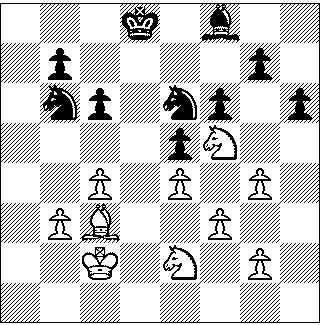
 I was white in this game and after an interesting fight we reached this position. My opponent had just played the careless 26. ... Bc5-f8? overlooking the reply 27. Ba5! with a permanent pin on the knight since it is impossible to extricate the knight from the pin (another example of a permanent pin would be if say a black rook were on a8 and a black knight on b8 and a white rook came to the 8th rank; neither the rook nor the knight can ever move without heavy material loss). It turns out material loss is inevitable here; Black played the lacklustre 27. ... Bc5 and after 28. b4 he was forced to resign since after the further 28. ... Bf2 29. c5 he loses the knight (if 28. ... Bxb4 best is 29. Bxb6+). A better defence is provided by 27. ... Kc7 28. b4 (threatening to win a piece with 29. c5) c5! when the natural 29. b5 looking to maintain the pin is incorrect due to the resource 29. ... Nd4+! 30. Nexd4 cxd4 and Black threatens to untangle with g6, Bc5 and Kd6. So White must be content here with 31. Nxg7 Bxg7 32. c5 winning a pawn but with an endgame which is not easy to convert. Instead after 28. ... c5 best is 29. Nc3! (threatening Nd5+) 29. ... Kc6 (unpinning the knight and apparently defending everything) 30. b5+! Kc7 31. Nd5+ finally wins a piece. It would be a good exercise to work out all the possible lines after 27. Ba5 Kc7 and work out how White can win in each line, since a lot of different ideas come up in the analysis. The point however is that Black should not allow the pin to arise in the first place. Instead of 26. ... Bf8?, simply 26. ... Kd7 is correct; white has a slight advantage in the resulting ending but it is probably not enough to win.
Another example again from one of my games- this time I was on the receiving end.
 I was black in this game, and it's my move. Though I am two pawns up, White has some compensation, as Black's kingside pawn structure is compromised. Here Black should probably play something like 36. ... Rc7 giving up the f5 pawn but maintaining good winning chances due to the connected passed pawns on the q-side (White's k-side pawn majority is much harder to exploit). Instead without much thought I played the natural 36. ... g6? and my opponent replied with 37. hxg6+ fxg6 (not 37. ... Kxg6?? 38. Rg3+ Kh5 39. Rh1#) 38. Rh1+ Kg7 39. Rh3!. Suddenly Black's in big trouble- white's rooks get to penetrate to the 7th rank and the position gets extremely messy. In fact, in the game, White's powerful initiative enabled him to win back the material with interest, and we reached an even material ending which was probably winning for White. However, having fought so well, White blundered near the end, so I got a most undeserved victory. This is a perfect example of the danger of relaxing in the endgame- with queens on the board I would probably be very careful before playing a commital move like ... g6, but with queens off I thought I could play it safely. I almost lost a point as a result.
So the next time you reach an endgame, keep an eye out for possible tactics: you never know where they might lurk!

No comments:
Post a Comment