Openings... this most elusive part of a chess game. For some of us it barely passes in a flash, nothing but a prelude to bigger and better things; for others the opening is chess, to be studied and prepared before games, to be applied purposefully during games, to be analysed after games. Whatever way you look at the opening, it is without doubt one of the most crucial stages of the game; so it is important to have one's own approach towards openings.
The first thing to realize is that if your approach is over-simplistic it's probably not particularly great. Just about every chess coach preaches, "Don't memorize openings, just learn a few opening rules and you'll be fine etc etc" and of course there is no doubt that heavy memorization of openings is unhelpful. But it is also easy to lean to the other extreme and purposely avoid memorizing any lines at all, if only to stick to a principle. The result can be too many games going something like e4 e5 Nf3 Nc6 Nc3 Nf6 Bc4 Bc5 d3 d6 etc, and by the time you reach the middlegame you realize you have reached a stale dull position which you just hate to play. So there has to be a compromise of some sort- you need to know the principles well because you are bound to play games where you or your opponent veer out of the main line, and also because it saves time which you can use to learn other aspects of chess; but some memorization is required if you are going to get good positions out of the opening.
A second point to consider is what opening to play; and this depends very much on your chess style. A fundamental decision to make is whether to play 1. e4 or 1. d4 (or other openings such as 1. c4 or 1. Nf3). The common rule-of-thumb is that if you have a 'positional' style play 1. d4; if instead you have a 'tactical' style play 1. e4. It is a useful guidline but not completely true of course; there is plenty of scope for dynamic play with 1. d4 (many of the lines in the QGD or Slav where white allows black to win the c4 pawn) and many grandmasters with quieter styles have nevertheless played 1. e4 (Karpov is a good example). Another decision to make is what openings to play as Black against the common white openings. But I think more important than what opening you choose is how you play it. A good method I think is to understand the point of the opening, so to speak, and know the plans from typical positions that arise from the opening. Then browse quickly through a few main lines and skim through a few games in the opening, just to get a feel for what kind of moves are 'right' in the opening. Next comes the obvious but important step- play a few games with that opening even if you haven't mastered the ins and outs of the opening. There is no better way of learning an opening than to actually play games with it- you are confronted with actual problems set by your opponent, and this gives a sense of urgency not present in the relaxed atmosphere of home analysis. (Also this is more fun!) Having played a game, then is a good time to look up the theory of the particular line played in the game. If you play enough games in the opening, very soon you will pretty much have mastered that opening; while at the same time you have avoided the other extremely dull method of studying openings, which is to pore through relentlessly long variations from a fat book until you fall asleep!
More on openings in a future post. Criticisms and suggestions are welcome!
Wednesday, August 16, 2006

Monday, August 07, 2006
I'm back
Anyone who has checked out this blog must have wondered why the 'daily' dose of chess has only 5 posts in about 5 months. The reason is that I had very gruelling A'Level exams recently and forgot completely about this blog's existence. Well, now my exams are over, so here I am! Be warned though that I have become more sane now; which means I will only be posting once a week (or two at most). Hopefully the quality of my posts will improve as a result. The name of the blog, however, will remain the same- the weekly dose of chess just sounds silly.
Tuesday, March 14, 2006
Endgame tactics
The middlegame is the ultimate battlefield for tactics- the greater number of pieces often give rise to multiple tactical possibilities not possible in the endgame(when there are too few pieces) or the opening (when most of the pieces are yet to enter battle). As a result, tactical puzzles and problems you find in books, magazines and other sources are almost always from a middlegame position. And that is right too, since the ability to spot tactics and correctly calculate them is most necessary in the middlegame. But there is a snag.
Players who are always vigilant in the middlegame about possible tactics may tend to relax when they reach the endgame. There is a perception that the endgame is just about technique and planning; but that is wrong! Tactics can crop up in the endgame in the most unexpected places, and many games can be won and lost in the endgame as a result. What is more, tactics in the endgame are often different from those arising in the middlegame, and this can make it even more difficult to spot them. The moral? You have to be extra vigilant in the endgame, and double-check every move you make!
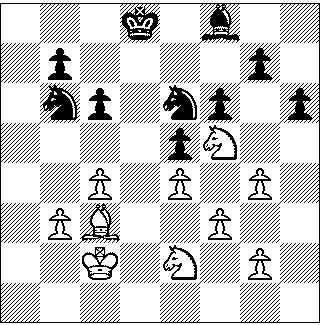
Here are a couple of examples from some of my own games.
Players who are always vigilant in the middlegame about possible tactics may tend to relax when they reach the endgame. There is a perception that the endgame is just about technique and planning; but that is wrong! Tactics can crop up in the endgame in the most unexpected places, and many games can be won and lost in the endgame as a result. What is more, tactics in the endgame are often different from those arising in the middlegame, and this can make it even more difficult to spot them. The moral? You have to be extra vigilant in the endgame, and double-check every move you make!
Here are a couple of examples from some of my own games.

Another example again from one of my games- this time I was on the receiving end.

So the next time you reach an endgame, keep an eye out for possible tactics: you never know where they might lurk!
Friday, March 10, 2006
Stoyko Exercises
I came across the idea of Stoyko exercises recently in Dan Heisman's website, and I found them to be really useful.
In a nutshell, what you do is take a very complicated position (preferably an open, messy position with unbalanced material and lots of potential tactics). Set it up on a board and take a pen and piece of paper. Now you have to analyse the position as deeply as you can, without moving the pieces, and write down your analysis in the paper together with an evaluation of the final position (e.g. Black is slightly better, White is winning). You have to include all variations, but you have to specify which is the best line for both sides. This exercise should take 1 or 2 hours (if it doesn't, either you are not analysing deeply enough or your chosen position is not complicated enough). At the end of the exercise, you can check with your analysis with a strong player or your computer.
This is a really great exercise to work on, because not only are you practising your analysis and visualization skills, you are also practising how to evaluate positions. Crucially, the exercise also helps you become better at handling sharp, open positions. Why is this important given that most positions that arise in games are comparatively balanced and 'normal'? This is because normal positions are a lot easier to handle in general, whearas in sharp positions even very good players can make big errors. So sharp positions are in effect the key positions in the games, the ones whose outcome can have a decisive effect on the game result. I have noticed that a lot of players may purposefully shrink away from playing a sharp variation in a game and stick with a 'safer' line (even though the sharp line may be the objectibely better continuation), and while this is good for you short-term results and probably good for your heart as well, it is detrimental to your long-term improvement in chess. Stoyko exercises, by forcing you to calculate a lot of variations very deeply, will naturally make you more adept than your average opponent in handling sharp positions that arise in your games. In fact, with your new-found skills, you might even deliberately steer your games into unbalanced positions (remember Tal?).
For more about Stoyko exercises, check out Heisman's website (http://mywebpages.comcast.net/danheisman/Articles/Articles.html); and do give them a try and let me know whether you like the idea. Good luck!
In a nutshell, what you do is take a very complicated position (preferably an open, messy position with unbalanced material and lots of potential tactics). Set it up on a board and take a pen and piece of paper. Now you have to analyse the position as deeply as you can, without moving the pieces, and write down your analysis in the paper together with an evaluation of the final position (e.g. Black is slightly better, White is winning). You have to include all variations, but you have to specify which is the best line for both sides. This exercise should take 1 or 2 hours (if it doesn't, either you are not analysing deeply enough or your chosen position is not complicated enough). At the end of the exercise, you can check with your analysis with a strong player or your computer.
This is a really great exercise to work on, because not only are you practising your analysis and visualization skills, you are also practising how to evaluate positions. Crucially, the exercise also helps you become better at handling sharp, open positions. Why is this important given that most positions that arise in games are comparatively balanced and 'normal'? This is because normal positions are a lot easier to handle in general, whearas in sharp positions even very good players can make big errors. So sharp positions are in effect the key positions in the games, the ones whose outcome can have a decisive effect on the game result. I have noticed that a lot of players may purposefully shrink away from playing a sharp variation in a game and stick with a 'safer' line (even though the sharp line may be the objectibely better continuation), and while this is good for you short-term results and probably good for your heart as well, it is detrimental to your long-term improvement in chess. Stoyko exercises, by forcing you to calculate a lot of variations very deeply, will naturally make you more adept than your average opponent in handling sharp positions that arise in your games. In fact, with your new-found skills, you might even deliberately steer your games into unbalanced positions (remember Tal?).
For more about Stoyko exercises, check out Heisman's website (http://mywebpages.comcast.net/danheisman/Articles/Articles.html); and do give them a try and let me know whether you like the idea. Good luck!
Tuesday, March 07, 2006
Non-standard pawn sacrifices
We all know about the common types of pawn sacrifices, e.g. pawn sacs to open lines for an attack, usually conducted against the king; sacrifices to create an important outpost for a piece (these are the positional sacrifices, so to speak); sacrifices to disrupt the enemy pawn structure and sacrifices to gain time to build up an attack. It's instructive therefore to consider other positions where, at first glance, a pawn sacrifice may not look obvious or sound, but upon deeper analysis turns out to be the only correct route.
One such kind is the pawn sacrifice whose object is merely to gain time to improve the positioning of the pieces, with no immediate plans for attack. These can occur in situations where one side is up material but is behind in development or has inferiorly placed pieces; then often the best course of action for the side is to choose a suitable time to give back the pawn and using the time gained improve the piece positioning. It is really tempting in such positions to try to hold on to the extra pawn. This is even more so because often this can be the most effective course of action, but sometimes returning the material can be the only way to gain a decent position.
Here is a position from the recent Topalov-Svidler game in Linares a few days ago which illustrates the above ideas.
One such kind is the pawn sacrifice whose object is merely to gain time to improve the positioning of the pieces, with no immediate plans for attack. These can occur in situations where one side is up material but is behind in development or has inferiorly placed pieces; then often the best course of action for the side is to choose a suitable time to give back the pawn and using the time gained improve the piece positioning. It is really tempting in such positions to try to hold on to the extra pawn. This is even more so because often this can be the most effective course of action, but sometimes returning the material can be the only way to gain a decent position.
Here is a position from the recent Topalov-Svidler game in Linares a few days ago which illustrates the above ideas.

So Topalov, after 19. ... Qa5, played the stronger 20. Nc3!, and after 20. ... Qxa3 21. Nd5 (see position below), the transformation in the position is striking.

Such decisions come naturally to strong GMs, but for us ordinary mortals, it can often be difficult to correctly evaluate positions like this where the side with the more material may not always be better off. That is why it is important to study games played by masters, in order to gain a 'feel' for such positions so that when they arise in our own games we are comfortable playing them.
Saturday, March 04, 2006
Linares
So the Linares tournament has finally begun at Linares itself, with eight heavyweight chess players returning to Spain to continue from where they left off at Morelia. It must be said that though that the Morelia section of the tournament was a success; compared to previous years, the proportion of draws is small and the games have been, overall, well-fought. Even so, it's great to see the grand old tournament return to its traditional home.
Okay, today I will have a look at the game between Radjabov and Aronian from yesterday's round, an exciting encounter which ended (sadly) in a relatively early draw.
Radjabov,T (2700) - Aronian,L (2752) [D38]
XXIII SuperGM Morelia/Linares MEX/ESP (8), 03.03.2006
1. d4 Nf6 2. c4 e6 3. Nf3 d5 4. Nc3 Bb4
This is a relatively rare line which somewhat resembles the Nizmo-Indian, with the difference that Black has already played d5.
5. cxd5 exd5 6. Bg5 Nbd7 7. e3 c5
The thematic response, challenging white's center. Of course, dxc5 now would give Black an isolated d-pawn, but his active pieces more than compensate for it.
8. Bd3 Qa5
A more common move-order is 8. ... c4 9. Bf5 Qa5 10. Qc2. This move unpins the f6 knight and threatens to take on c3 twice.
9. O-O
Apparently giving up the c3 pawn, but in fact it cannot be taken safely. If now 9. ... Bxc3 10. bxc3 Qxc3 (c4 11. Bf5 transposes to the game) 11. Rc1 gives white a strong initiative- for example 11. ... Qa3 12. Bxf6 Nxf6 (he can try to hold the pawn with gxf6 but then Black's pawn structure is horrible) 13. Rxc5 and now if 13. ... O-O 14. Qc2 gives White a large edge due to his control of the c-file, while on 13. ... Qxa2 14. Bb5+! Bd7 (Nd7 15. Ne5 is extremly powerful) 15. Bxd7+ Nxd7 16. Rc7! threatens b7 and prevents castling, when white is clearly better.
9. ... c4 10. Bf5 Bxc3
The consistent continuation, leaving white with a weakling on c3.
11. bxc3 Ne4!
White has got quite some pressure on Black's position, so it's logical for Black to exchange pieces. 11. ... Qxc3? fails to 12. Qa4! when Black's queen is trapped and 13. Rac1 is threatened. If then 12. ... Ne4 13. Rac1 Qb2 14. Rb1 Qc3 15. Bxe4! dxe4 16. Rfc1 Qd3 17. Ne5! wins material.
12. Qc2
12. Bxe4?! sets a dastardly trap- 12. ... dxe4 13. Ne5 (forced, since on other knight moves there is Qg5) Nxe5 14. dxe5 Qxe5?? 15. Qd8#. But after the simple 14. ... 0-0 White is left with weak pawn on e5 and c3 and has much the inferior position.
12. ... Ndf6
12. ... Qxc3?? loses to 13. Bxe4. 12. ... Nxc3 looks very risky becuase of 13. Qd2! when the knight is pinned and can hardly be saved. 12. ... Nxg5 is the other option but after 13. Nxg5 g6 weakens the dark squares gravely while 13. ... h6 can be met by the simple 14. Nf3 or the interesting Nh7!? preventing castling and preparing g2-g4-g5. The game continuation is the most principled, preparing further exchanges.
13. Bxc8 Rxc8 14. Bxf6 Nxf6 15. Rfb1?!
A relatively new idea in this position, since White generally plays moves like Nd2, Rfe1 and an eventual e4 here. As the game goes, though, the rooks become stuck on the queenside so maybe white should have played the simpler Nd2 or Ne5.
15. ... b6
Not 15. ... b5? 16. a4! when the q-side suddenly opens up while black is still under-developed.
16. Rb4
Threatening 17. Ra4
16. ... Qa6 17. Nd2
Aronian has smoothly met Radjabov's Q-side threats so White prepares the thematic e3-e4 break. White is slightly better here since Black may find it hard to mobilise his Q-side pawn mass while White has a clear plan of f2-f3 and e3-e4.
17. ... O-O 18. f3 Nh5!?
This is an interesting idea, the point of which is that if White continues with 19. e4? Nf4! and the knight gets a fine outpost on d3. So White is forced to weaken his kingside as a result.
As we shall see later, Aronian's plan in this game is to allow e2-e4 from White but reduce its effectiveness. But Black can also try to make something of his own Q-side pawn majority, so another possibility is 18. ... Qb7 19. e4 b5 20. e5 with an unbalanced position where White will press on the k-side while Black will attack on the Q-side.
19. g3 Rce8
The straightforward 19. ... Rfe8 looks more logical, seeking to use the c8 rook to direct operations on the Q-side.
20. e4 b5!
Innovative play from Aronian! The idea is not so much to mobilize the Q-side but to shuttle the queen over to the kingside and look for tactical opportunites there. Suddenly the weakened kingside may become a problem for White.
Other possibilities look unpromising- 20. ... Qb7 21. Re1 b5 22. e5. The point is that as soon as White gets his rooks co-ordinated he has the better game (since his pawns are advancing much faster), so Black has to look for a way to disrupt White's game before he can do that.
21. Re1
Trying to support the center and the kingside using the rook. Of course it is a pity to have the e4 rook pinned to the rook, but other options may be worse. 21. exd5? Re2! is obviously better for black, who can double rooks on the e-file and build up a big attack on the king (if 22. Qf5? Rxd2 23. Qxh5 Re8! the doubled rooks on the seventh rank will be extremely dangerous.
The natural move is 21. a4 but now after 21. ... Qg6! as in the game White can win the b5 pawn but it's hard to see what defence he has against the perpetual resulting from dxe4 and Nxg3.
21. ... Qg6! 22. Rxb5
This leads to a draw by force so let's see if Radjabov had any better move. 22. Rbb1 is one possibility, looking to meet 22. ... dxe4 with 23. Nxe4 (the point of Rbb1 is that f5 now doesn't win the knight which can safely retreat to f2) But after 22. ... a6, Black has a very active position and his knight threatens the manoevre Nh5-f4-d3. 22. Kg2? is met by 22. ... Nf4+ reaching d3 with tempo.
22. ... dxe4
Not 22. ... Nxg3? 23. hxg3 Qxg3+ 24. Kf1 Qh3+ 25. Ke2 and the king escapes via d1. (if 24. ... dxe4 25. Rxe4!)
23. fxe4
While watching the game, I thought that here White had to play 23. Rxh5! seemingly avoiding the threat of a perpetual. Then on 23. ... Qxh5 24. dxe4, Black has no perpetual and White, with a pawn and a powerful central pawn mass for the exchange, is much better.
However, later I realised that 23. Rxh5? is refuted by 23. ... e3!! A weird position, where White's queen, knight and rook are all hanging! Now if 24. Ne4 Qxh5 25. Rxe3 is not possible due to 25. ... f5 winning the knight, and here Black's extra exchange does give him a large advantage.
So 24. Qxg6 is forced when after 24. ... fxg6 25. Re5 (if the knight moves gxh5 is decisive; if the rook moves anywhere else, say b5, Black wins immediately with 25. ... exd2 26. Rd1 Re1+ +-; or 26. Rf1 Rxf3! 27. Rbb1 Rfe3! 28. Kf2 Re2+ wins) Rxe5 26. dxe5 exd2 27. Rd1 Rxf3 28. Rxd2 Rxc3 with the advantage in the ending due to the advanced passed c-pawn.
Other moves on move 23 are worse- 23. Rxe4 Nf6 wins the exchange (the rook is pinned to the c2 queen) or 23. Nxe4 f5 wins the pinned knight- this time exploiting the pin on the e-file. So White has no choice but to allow the perpetual.
23. ... Nxg3 24. hxg3 Qxg3+ 25. Kf1 Qf4+ (not 25. ... Re6 26. Rf5!) 26. Ke2 Qg4+ 27. Kf2 Qh4+ 28. Ke2 Qg4+ 29. Kf2 1/2-1/2
Okay, today I will have a look at the game between Radjabov and Aronian from yesterday's round, an exciting encounter which ended (sadly) in a relatively early draw.
Radjabov,T (2700) - Aronian,L (2752) [D38]
XXIII SuperGM Morelia/Linares MEX/ESP (8), 03.03.2006
1. d4 Nf6 2. c4 e6 3. Nf3 d5 4. Nc3 Bb4
This is a relatively rare line which somewhat resembles the Nizmo-Indian, with the difference that Black has already played d5.
5. cxd5 exd5 6. Bg5 Nbd7 7. e3 c5
The thematic response, challenging white's center. Of course, dxc5 now would give Black an isolated d-pawn, but his active pieces more than compensate for it.
8. Bd3 Qa5
A more common move-order is 8. ... c4 9. Bf5 Qa5 10. Qc2. This move unpins the f6 knight and threatens to take on c3 twice.
9. O-O
Apparently giving up the c3 pawn, but in fact it cannot be taken safely. If now 9. ... Bxc3 10. bxc3 Qxc3 (c4 11. Bf5 transposes to the game) 11. Rc1 gives white a strong initiative- for example 11. ... Qa3 12. Bxf6 Nxf6 (he can try to hold the pawn with gxf6 but then Black's pawn structure is horrible) 13. Rxc5 and now if 13. ... O-O 14. Qc2 gives White a large edge due to his control of the c-file, while on 13. ... Qxa2 14. Bb5+! Bd7 (Nd7 15. Ne5 is extremly powerful) 15. Bxd7+ Nxd7 16. Rc7! threatens b7 and prevents castling, when white is clearly better.
9. ... c4 10. Bf5 Bxc3
The consistent continuation, leaving white with a weakling on c3.
11. bxc3 Ne4!
White has got quite some pressure on Black's position, so it's logical for Black to exchange pieces. 11. ... Qxc3? fails to 12. Qa4! when Black's queen is trapped and 13. Rac1 is threatened. If then 12. ... Ne4 13. Rac1 Qb2 14. Rb1 Qc3 15. Bxe4! dxe4 16. Rfc1 Qd3 17. Ne5! wins material.
12. Qc2
12. Bxe4?! sets a dastardly trap- 12. ... dxe4 13. Ne5 (forced, since on other knight moves there is Qg5) Nxe5 14. dxe5 Qxe5?? 15. Qd8#. But after the simple 14. ... 0-0 White is left with weak pawn on e5 and c3 and has much the inferior position.
12. ... Ndf6
12. ... Qxc3?? loses to 13. Bxe4. 12. ... Nxc3 looks very risky becuase of 13. Qd2! when the knight is pinned and can hardly be saved. 12. ... Nxg5 is the other option but after 13. Nxg5 g6 weakens the dark squares gravely while 13. ... h6 can be met by the simple 14. Nf3 or the interesting Nh7!? preventing castling and preparing g2-g4-g5. The game continuation is the most principled, preparing further exchanges.
13. Bxc8 Rxc8 14. Bxf6 Nxf6 15. Rfb1?!
A relatively new idea in this position, since White generally plays moves like Nd2, Rfe1 and an eventual e4 here. As the game goes, though, the rooks become stuck on the queenside so maybe white should have played the simpler Nd2 or Ne5.
15. ... b6
Not 15. ... b5? 16. a4! when the q-side suddenly opens up while black is still under-developed.
16. Rb4
Threatening 17. Ra4
16. ... Qa6 17. Nd2
Aronian has smoothly met Radjabov's Q-side threats so White prepares the thematic e3-e4 break. White is slightly better here since Black may find it hard to mobilise his Q-side pawn mass while White has a clear plan of f2-f3 and e3-e4.
17. ... O-O 18. f3 Nh5!?
This is an interesting idea, the point of which is that if White continues with 19. e4? Nf4! and the knight gets a fine outpost on d3. So White is forced to weaken his kingside as a result.
As we shall see later, Aronian's plan in this game is to allow e2-e4 from White but reduce its effectiveness. But Black can also try to make something of his own Q-side pawn majority, so another possibility is 18. ... Qb7 19. e4 b5 20. e5 with an unbalanced position where White will press on the k-side while Black will attack on the Q-side.
19. g3 Rce8
The straightforward 19. ... Rfe8 looks more logical, seeking to use the c8 rook to direct operations on the Q-side.
20. e4 b5!
Innovative play from Aronian! The idea is not so much to mobilize the Q-side but to shuttle the queen over to the kingside and look for tactical opportunites there. Suddenly the weakened kingside may become a problem for White.
Other possibilities look unpromising- 20. ... Qb7 21. Re1 b5 22. e5. The point is that as soon as White gets his rooks co-ordinated he has the better game (since his pawns are advancing much faster), so Black has to look for a way to disrupt White's game before he can do that.
21. Re1
Trying to support the center and the kingside using the rook. Of course it is a pity to have the e4 rook pinned to the rook, but other options may be worse. 21. exd5? Re2! is obviously better for black, who can double rooks on the e-file and build up a big attack on the king (if 22. Qf5? Rxd2 23. Qxh5 Re8! the doubled rooks on the seventh rank will be extremely dangerous.
The natural move is 21. a4 but now after 21. ... Qg6! as in the game White can win the b5 pawn but it's hard to see what defence he has against the perpetual resulting from dxe4 and Nxg3.
21. ... Qg6! 22. Rxb5
This leads to a draw by force so let's see if Radjabov had any better move. 22. Rbb1 is one possibility, looking to meet 22. ... dxe4 with 23. Nxe4 (the point of Rbb1 is that f5 now doesn't win the knight which can safely retreat to f2) But after 22. ... a6, Black has a very active position and his knight threatens the manoevre Nh5-f4-d3. 22. Kg2? is met by 22. ... Nf4+ reaching d3 with tempo.
22. ... dxe4
Not 22. ... Nxg3? 23. hxg3 Qxg3+ 24. Kf1 Qh3+ 25. Ke2 and the king escapes via d1. (if 24. ... dxe4 25. Rxe4!)
23. fxe4
While watching the game, I thought that here White had to play 23. Rxh5! seemingly avoiding the threat of a perpetual. Then on 23. ... Qxh5 24. dxe4, Black has no perpetual and White, with a pawn and a powerful central pawn mass for the exchange, is much better.
However, later I realised that 23. Rxh5? is refuted by 23. ... e3!! A weird position, where White's queen, knight and rook are all hanging! Now if 24. Ne4 Qxh5 25. Rxe3 is not possible due to 25. ... f5 winning the knight, and here Black's extra exchange does give him a large advantage.
So 24. Qxg6 is forced when after 24. ... fxg6 25. Re5 (if the knight moves gxh5 is decisive; if the rook moves anywhere else, say b5, Black wins immediately with 25. ... exd2 26. Rd1 Re1+ +-; or 26. Rf1 Rxf3! 27. Rbb1 Rfe3! 28. Kf2 Re2+ wins) Rxe5 26. dxe5 exd2 27. Rd1 Rxf3 28. Rxd2 Rxc3 with the advantage in the ending due to the advanced passed c-pawn.
Other moves on move 23 are worse- 23. Rxe4 Nf6 wins the exchange (the rook is pinned to the c2 queen) or 23. Nxe4 f5 wins the pinned knight- this time exploiting the pin on the e-file. So White has no choice but to allow the perpetual.
23. ... Nxg3 24. hxg3 Qxg3+ 25. Kf1 Qf4+ (not 25. ... Re6 26. Rf5!) 26. Ke2 Qg4+ 27. Kf2 Qh4+ 28. Ke2 Qg4+ 29. Kf2 1/2-1/2
Friday, March 03, 2006
Hello!
I am Nahim Bin Zahur from Bangladesh and I am an avid chess player. I play mostly in the chess server FICS under the handle NBZ, though sometimes I take part in OTB tournaments. My interests in life (other than chess of course) include football, soccer, reading, mathematics and music.
In this blog I will annotate chess games, discuss current chess events and basically talk about anything to do with chess, though sometimes I may divert to other topics as well. I will try to post at least once every day, but no guarantees please! So wish me luck as I embark on my first blog ever.
In this blog I will annotate chess games, discuss current chess events and basically talk about anything to do with chess, though sometimes I may divert to other topics as well. I will try to post at least once every day, but no guarantees please! So wish me luck as I embark on my first blog ever.
Subscribe to:
Comments (Atom)